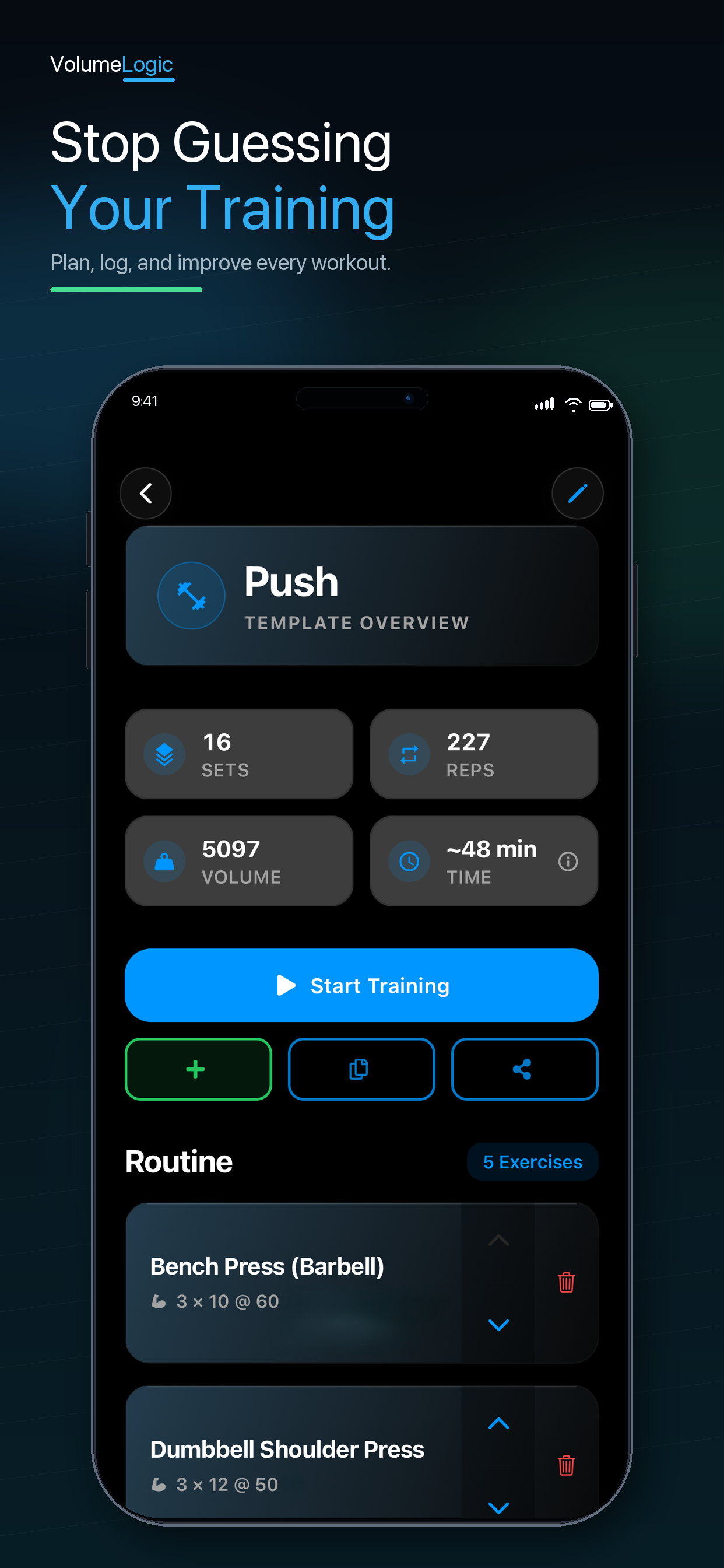
The best upper/lower split matches your training experience and uses four repeatable workouts: Upper A, Lower A, Upper B, and Lower B. The beginner plan below is machine-first; the intermediate version uses heavy barbell-focused A sessions and accessory-oriented B sessions.
Run the four workouts in that order. A fifth day is optional and repeats an existing workout—it is never a separate fifth template.
Choose your upper/lower plan
| Plan | Level | Frequency | Session length | Best for |
|---|---|---|---|---|
| Upper/Lower Beginner | Beginner | 4–5 sessions/week | Approximately 45–60 minutes/session | Beginners moving to a split who can train four or five days and prefer machines for most compound movements |
| Upper/Lower Intermediate | Intermediate | 4–5 sessions/week | Typically 45–60 minutes/session | Intermediate lifters wanting a clear upper/lower structure without committing to six gym days |
Begin with four days unless you already know that a fifth exposure improves a clear priority without harming recovery.
Upper/Lower Beginner
These are four machine-first templates. Run Upper A, Lower A, Upper B, Lower B. For a fifth session, repeat the lightest or highest-priority workout.
Upper A
| Exercise | Equipment | Sets | Reps |
|---|---|---|---|
| Chest Press | Machine | 3 | 12 |
| Chest-Supported Row | Machine | 3 | 12 |
| Shoulder Press | Machine | 3 | 12 |
| Lat Pulldown | Machine | 3 | 12 |
| Rear Delt Fly | Machine | 3 | 15 |
Lower A
| Exercise | Equipment | Sets | Reps |
|---|---|---|---|
| Leg Press | Machine | 3 | 12 |
| Seated Leg Curl | Machine | 3 | 12 |
| Leg Extension | Machine | 3 | 12 |
| Hip Thrust | Machine | 3 | 12 |
| Standing Calf Raise | Machine | 3 | 15 |
Upper B
| Exercise | Equipment | Sets | Reps |
|---|---|---|---|
| Bench Press | Smith Machine | 3 | 10 |
| Assisted Pull-up | Machine | 3 | 10 |
| Lateral Raise | Machine | 3 | 12 |
| Chest-Supported Row | Machine | 3 | 12 |
| Biceps Curl | Machine | 2 | 12 |
| Triceps Extension | Machine | 2 | 12 |
Lower B
| Exercise | Equipment | Sets | Reps |
|---|---|---|---|
| Hack Squat | Machine | 3 | 12 |
| Lying Leg Curl | Machine | 3 | 12 |
| Calf Press | Leg Press Machine | 3 | 15 |
| Hip Abduction | Machine | 3 | 15 |
| Hip Adduction | Machine | 3 | 15 |
Upper/Lower Intermediate
This plan uses heavy barbell-focused A sessions plus accessory-oriented B sessions with dumbbells, machines, pull-ups, dips, and core work. An optional fifth day repeats the weakest block.
Upper A — Heavy
| Exercise | Equipment | Sets | Reps |
|---|---|---|---|
| Barbell Bench Press | Barbell | 4 | 5 |
| Barbell Row | Barbell | 4 | 6 |
| Barbell Overhead Press | Barbell | 3 | 6 |
| Skull Crushers | EZ-Bar | 3 | 10 |
Lower A — Heavy
| Exercise | Equipment | Sets | Reps |
|---|---|---|---|
| Barbell Squat | Barbell | 4 | 5 |
| Romanian Deadlift | Barbell | 3 | 8 |
| Standing Calf Raise | — | 4 | 15 |
Upper B — Accessory
| Exercise | Equipment | Sets | Reps |
|---|---|---|---|
| Incline Bench Press | Dumbbells | 3 | 10 |
| Pull-ups | — | 3 | 8 |
| Arnold Press | Dumbbells | 3 | 10 |
| Lat Pulldown | Machine | 3 | 12 |
| Triceps-Focused Dips | — | 3 | 10 |
Lower B — Accessory
| Exercise | Equipment | Sets | Reps |
|---|---|---|---|
| Leg Press | Machine | 3 | 10 |
| Leg Extension | Machine | 3 | 12 |
| Seated Leg Curl | Machine | 3 | 12 |
| Hanging Leg Raise | — | 3 | 12 |
The listed sets are working sets. Use gradual warm-ups before heavy barbell work without counting them as prescribed work.
The base four-day schedule
The base rotation is Upper A, Lower A, Upper B, Lower B. A simple week is:
| Day | Session |
|---|---|
| Monday | Upper A |
| Tuesday | Lower A |
| Wednesday | Rest |
| Thursday | Upper B |
| Friday | Lower B |
| Saturday | Rest |
| Sunday | Rest |
Other weekdays can work. Preserve the sequence, include recovery, and avoid scheduling two upper workouts or two lower workouts on consecutive days.
For five-day options, see upper/lower split: four versus five days.
How the optional fifth day works
The fifth day repeats one of the four existing workouts. Do not invent a new “specialization day.”
- Beginner: repeat the lightest or highest-priority workout.
- Intermediate: repeat the weakest block.
Place the repeat so it does not create same-region consecutive training days. A repeated Upper session must not sit immediately beside another Upper session, and the same applies to Lower. Rotate the repeated workout over time when there is no enduring priority.
Four days is the default because it already trains each region twice. The fifth session is useful only when you can recover from it and have a reason to repeat that block.
Progress without changing the plan
Start around two to three RIR. Complete the prescribed sets and repetitions with a controlled range of motion and stable form. Add the smallest practical load only after every prescribed repetition is complete at about two RIR.
For example, the intermediate bench press prescription is four sets of five. Do not add weight because the first set feels easy. Earn the increase by completing all four sets of five with consistent form and approximately two RIR. If you repeatedly miss reps, reduce the load and rebuild.
Beginners should apply the same rule to machines. The pin does not need to move every workout; more repeatable execution at the same load is progress while learning.
Rest and effort
Heavy barbell movements may need three to five minutes between sets. Other compound movements often need two to three minutes, while smaller machine or arm exercises may need 60–120 seconds. Rest longer when rushing would prevent you from completing the prescription.
Training to failure on every set is unnecessary. Starting at two to three RIR leaves room to learn, progress, and recover across four or five weekly sessions.
Why upper/lower works
Upper/lower makes frequency and session focus easy to understand: each region receives two exposures in the base rotation. It is not inherently superior to full-body or other splits. Evidence comparing split and full-body routines suggests similar strength and hypertrophy outcomes when volume is equated.
The practical benefits are organizational. Four days can accommodate enough exercise variety without requiring every session to train the whole body, and rest days can break up the rotation.
Common mistakes
Treating five days as automatically better
The fifth session increases work and recovery demand. Use four days until a repeated block serves a specific priority and performance remains stable.
Inventing a fifth workout
The program contains four templates. Repeat the prescribed lightest, priority, or weakest block instead of adding an untested collection of exercises.
Training the same region on consecutive days
Poor fifth-day placement can turn Upper B and the repeated Upper workout into consecutive sessions. Move the repeat or use four days that week.
Adding load after one good set
The progression threshold applies to all prescribed sets. A fast opening set does not erase later misses.
Rewriting the intermediate plan
The heavy and accessory labels describe distinct roles. Preserve their exercise order and prescription long enough to assess the intended structure.
Frequently asked questions
Is upper/lower good for beginners?
Yes, when a beginner can reliably train four days. The machine-first plan reduces technique demands while the repeated upper and lower structure remains easy to learn.
Is four or five days better?
Four is the base plan and best default. Five can suit someone recovering well who has a specific block worth repeating. It is not required for progress.
Can upper/lower build strength and muscle?
Yes. The intermediate plan combines lower-repetition heavy barbell work with moderate-repetition accessory work. Results still depend on productive effort, progression, nutrition, and recovery.
What should I repeat on day five?
Beginners repeat the lightest or highest-priority workout. Intermediates repeat the weakest block. Repeat one existing template and avoid same-region consecutive days.
What if I miss a day?
Continue with the next uncompleted workout instead of doubling sessions. If the optional fifth day no longer fits, drop it first and preserve the four base workouts.
The practical takeaway
Choose the plan that matches your experience, run Upper A, Lower A, Upper B, and Lower B, and treat day five as optional. Progress only after every prescribed repetition is complete with stable form at about two RIR.
If you are still choosing a structure, compare full body, upper/lower, PPL, and PPLUL by reliable weekly availability.
Sources
- Efficacy of Split Versus Full-Body Resistance Training on Strength and Muscle Growth: A Systematic Review With Meta-Analysis
- Effects of Resistance Training Frequency on Measures of Muscle Hypertrophy: A Systematic Review and Meta-Analysis
- Resistance Training to Failure vs. Not to Failure: Effects on Strength, Hypertrophy, and Muscle Architecture