Powerlifting program guide
Powerlifting Program for Beginners, Intermediate and Advanced Lifters
A practical guide to choosing a powerlifting program, setting your 1RM, managing weekly volume, and tracking squat, bench press, and deadlift progress over time.
Contents
Powerlifting program guide contents
Program selection
Which powerlifting program should you choose?
The best powerlifting program is the one that matches how fast you can recover and progress. A beginner powerlifting program should be simple enough to repeat hard practice often. An intermediate program needs weekly planning. An advanced program usually needs more volume, more variation, and slower peaking.
- Beginner: choose the 3-day plan if you can still add weight or reps most weeks while technique improves.
- Intermediate: choose the 4-day plan if progress shows up weekly or every few weeks and you need separate heavy, volume, and variation work.
- Advanced: use the peaking structure if you are preparing for a meet, mock meet, or planned 1RM test and already tolerate high workload.
Block setup
Set up the block before week 1
Run the beginner or intermediate block for 8 weeks. Use weeks 1-6 to build, week 7 to reduce fatigue, and week 8 to test a rep PR, heavy single, or new estimated 1RM. Advanced peaking blocks usually run 10-12 weeks because the lifter needs separate accumulation, intensification, and taper phases.
- Training max: base percentages on 90% of your current true 1RM, not your lifetime best. If you do not know your 1RM, estimate it from a recent hard set with the 1RM calculator.
- RPE and RIR: RPE 7 means about 3 reps in reserve, RPE 8 means about 2 reps in reserve, and RPE 9 means about 1 rep in reserve. Most work in this guide should stay at RPE 6-8 until the peak.
- Warm-up sets: start with 5-10 minutes of general movement, then use ramping sets for the first main lift: empty bar x 10, 40% x 5, 55% x 3, 70% x 2, 80% x 1, then working sets. Take smaller jumps if the bar feels slow.
- Rest periods: rest 2-4 minutes for main lift volume, 4-6 minutes for heavy singles or triples, and 60-120 seconds for accessories.
Accessories should support the competition lifts without turning the week into bodybuilding fatigue. Stop most accessories with 1-3 reps in reserve and keep them stable for the block unless recovery is excellent.
Beginner block
Powerlifting program for beginners: 8-week 3-day block
This beginner powerlifting program is a practical starting point. Train 3 non-consecutive days per week, use a training max around 90% of your true 1RM, keep most working sets around RPE 6-8, and add load only when the prescribed reps move well.
| Week | Squat and bench progression | Deadlift progression | Goal |
|---|---|---|---|
| 1 | 3x5 at 65-70% training max | 3x3 at 65-70% training max | Clean technique and easy finishes. |
| 2 | Add 2.5 kg / 5 lb if week 1 was RPE 8 or lower. | Add 2.5-5 kg / 5-10 lb if bar speed stayed strong. | Small overload without grinding. |
| 3 | Add the same jump or repeat week 2 if reps slowed. | Add load only if every set stayed crisp. | Build repeatable practice. |
| 4 | 4x4 at roughly week 3 load. | 3x3 at week 3 load. | More quality work at the same intensity. |
| 5 | 3x4 with a small load increase. | 4x2 with a small load increase. | Shift slightly heavier. |
| 6 | 3x3 at RPE 7-8. | 3x2 at RPE 7-8. | Practice heavier weights with no missed reps. |
| 7 | 2x3 at 60-65% training max. | 2x2 at 60-65% training max. | Deload and recover. |
| 8 | Work to a smooth heavy set of 3-5 or estimate a new 1RM. | Work to a smooth heavy set of 2-3 or estimate a new 1RM. | Measure progress without a reckless max attempt. |
Full beginner training week
| Day | Main lifts | Accessories | Progression rule |
|---|---|---|---|
| Day 1 | Squat 3x5 at RPE 7 Bench press 3x5 at RPE 7 | Row 3x8-12 Plank 3 sets | Add load next week if all reps are clean. |
| Day 2 | Deadlift 3x3 at RPE 7 Paused bench 3x6 at RPE 6-7 | Romanian deadlift 2x8 Lat pulldown 3x10 | Keep deadlift conservative. Do not grind. |
| Day 3 | Squat 3x5 at RPE 7 Bench press 4x4 at RPE 7-8 | Split squat 2x10 Triceps pressdown 3x12 | Add reps first if bar speed slows. |
Missed reps, deloads, and resets
- If you miss one rep: keep the same load next week and finish the remaining sets with 5-10% less weight.
- If you miss two or more reps: reduce that lift by 5% next week and rebuild from there.
- If a lift feels like RPE 9+ before the final set: stop adding weight that day and complete the work with a reduced load.
- If two weeks in a row regress: take a deload week at 60-70% of normal volume and load, then reset the training max down 5%.
- If only one lift stalls: reset only that lift. Do not lower squat, bench, and deadlift together unless recovery across the whole week is poor.
Intermediate week
Intermediate powerlifting program: full 4-day week
Use this when a simple 3-day beginner plan stops producing steady progress. The week gives each lift a heavy exposure, enough volume to build, and a variation slot to practice weak positions without maxing out.
| Day | Main lifts | Secondary work | Accessories |
|---|---|---|---|
| Day 1: Squat and bench heavy | Squat 1x3 at RPE 8, then 3x5 at 75% of that top set Bench press 1x3 at RPE 8, then 4x5 at 75% | Paused squat 2x4 at RPE 6 | Chest-supported row 3x8-12 Hamstring curl 3x10-15 |
| Day 2: Deadlift volume | Deadlift 4x4 at RPE 7 Close-grip bench 4x6 at RPE 7 | Tempo deadlift 2x3 at RPE 6 | Lat pulldown 3x8-12 Back extension 2x10-15 |
| Day 3: Bench volume | Bench press 5x5 at RPE 7 Front squat 3x5 at RPE 6-7 | Overhead press 3x6 at RPE 7 | Triceps pressdown 3x10-15 Rear delt raise 3x12-20 |
| Day 4: Variation and practice | Paused deadlift 3x3 at RPE 7 Competition squat 4x4 at RPE 7 | Spoto press or paused bench 3x5 at RPE 7 | Single-leg work 2x8-10 Ab wheel 3 sets |
Intermediate weekly progression
- Weeks 1-3: add 2.5 kg / 5 lb to squat and bench top sets when the top set is RPE 8 or lower. Add 2.5-5 kg / 5-10 lb to deadlift only when all reps are fast.
- Week 4: hold load steady and add one back-off set to squat, bench, or deadlift if recovery is good.
- Weeks 5-6: reduce reps on top sets from triples to doubles while keeping RPE around 8.
- Week 7: deload by cutting sets in half and using 60-70% of normal working load.
- Week 8: test a heavy single at RPE 8-9 or a rep PR, then update training maxes from what you actually lifted.
Advanced structure
Advanced powerlifting peaking structure
Advanced lifters should not turn every week into a test. The job of a peak is to carry enough volume to keep strength, practice heavy competition lifts, then remove fatigue so performance can show up on meet day or test day.
| Phase | Weeks | Main lift focus | Accessory focus |
|---|---|---|---|
| Accumulation | 1-4 | 3-6 rep work at RPE 6-8. Competition lifts plus close variations. | Higher accessory volume for upper back, triceps, quads, hamstrings, and trunk. |
| Intensification | 5-8 | Singles, doubles, and triples at RPE 7-8.5. Fewer variation lifts. | Moderate accessory volume. Remove anything that harms main lift recovery. |
| Peak | 9-10 | Competition squat, bench, and deadlift singles at RPE 8-9 with small back-off work. | Low accessory volume. Keep blood flow and confidence, not soreness. |
| Taper and test | 11-12 | Openers or heavy singles early, then short low-volume sessions before test day. | Minimal accessories. Prioritize sleep, body weight, and readiness. |
Example advanced peaking week
| Day | Competition lift work | Back-off work | Notes |
|---|---|---|---|
| Day 1 | Squat single at RPE 8 Bench single at RPE 8 | Squat 3x3 at 78-82% Bench 4x3 at 78-82% | Practice commands and consistent setup. |
| Day 2 | Deadlift single at RPE 8 | Deadlift 3x2 at 75-80% Paused bench 3x4 at RPE 7 | Keep the deadlift single fast enough to recover from. |
| Day 3 | Bench single at RPE 8-8.5 | Bench 5x2 at 80-85% Light squat 2x3 at 65-70% | Bench can usually tolerate more frequency than squat or deadlift. |
| Day 4 | Squat or deadlift technique single at RPE 7 | Chosen lift 2x2 at 70-75% Optional upper-back work 2-3 sets | Leave the gym feeling better than when you arrived. |
Tracking workflow
How to track a powerlifting program
- Start with conservative 1RMs. Use the 1RM calculator if you need an estimate from recent reps.
- Write the week before week 1. Set the squat, bench, deadlift, variation, and accessory slots in advance so the same work can be compared over time.
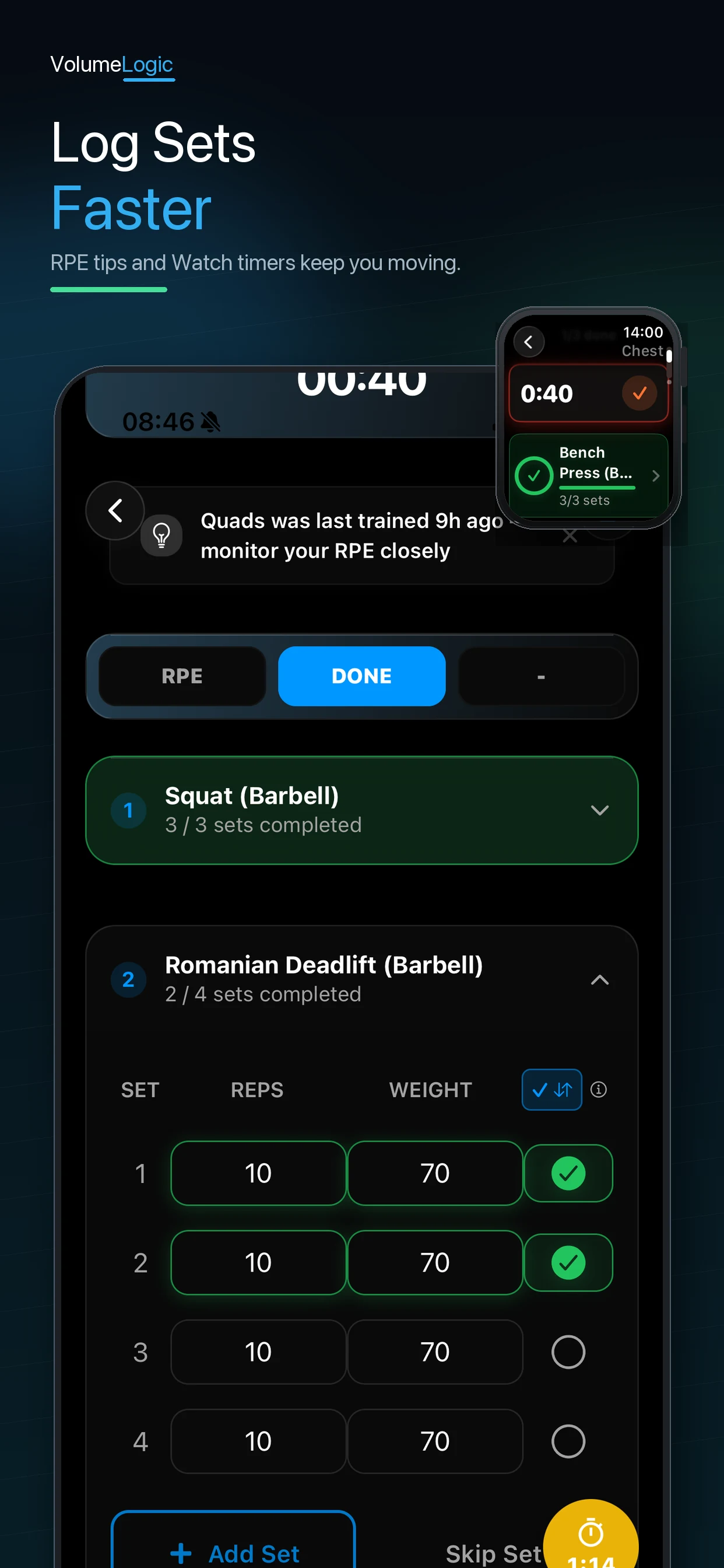
- Record every main lift set. Note reps, load, and RPE so heavy work is judged by performance quality, not weight alone.
- Watch weekly volume. Use the training volume guide to keep workload from spiking too fast.
- Review readiness before adding work. If RPE climbs and performance drops, hold load, reduce volume, or deload before forcing the next jump.
After the block
What to do after week 8 or test day
Do not jump straight from a hard test into another max-effort block. Take 3-7 easier training days, review the lifts honestly, and choose the next block from the result.
- If all three lifts improved: update training maxes conservatively and repeat the block with slightly heavier starting loads.
- If one lift improved and another stalled: keep the successful lift structure, reset the stalled lift 5%, and add only one targeted change such as more bench frequency or a paused squat slot.
- If everything felt worse: run a lower-volume recovery week, check sleep and food, then restart with training maxes 5-10% lower.
- If you have a meet soon: move into the advanced peaking structure instead of chasing more volume.
Common mistakes
Powerlifting program mistakes to avoid
- Testing maxes too often instead of building the lifts.
- Choosing an advanced structure before beginner progression is exhausted.
- Ignoring accessories that build muscle for the squat, bench, and deadlift.
- Using old lifetime PRs as training maxes instead of current strength.
- Adding volume to all three lifts at once when only one lift is stalled.
FAQ
Powerlifting program FAQ
What is the best powerlifting program for beginners?
The best beginner powerlifting program is usually a simple 3 day plan with frequent squat, bench press, and deadlift practice, conservative loading, and a small number of accessories.
Should a powerlifting program use percentages or RPE?
Both can work. Percentages give structure from your 1RM, while RPE adjusts for daily performance. Many lifters use percentages for the plan and RPE to decide whether to hold, add, or reduce load on the day.
How long should a powerlifting block be?
Beginner and intermediate blocks commonly run 8 weeks: 6 build weeks, 1 deload week, and 1 test or rep PR week. Advanced peaking blocks often run 10 to 12 weeks.
How should I track a powerlifting program?
Track the main lift, sets, reps, load, and RPE for each session. Review weekly volume, missed reps, and recovery before changing the next week.