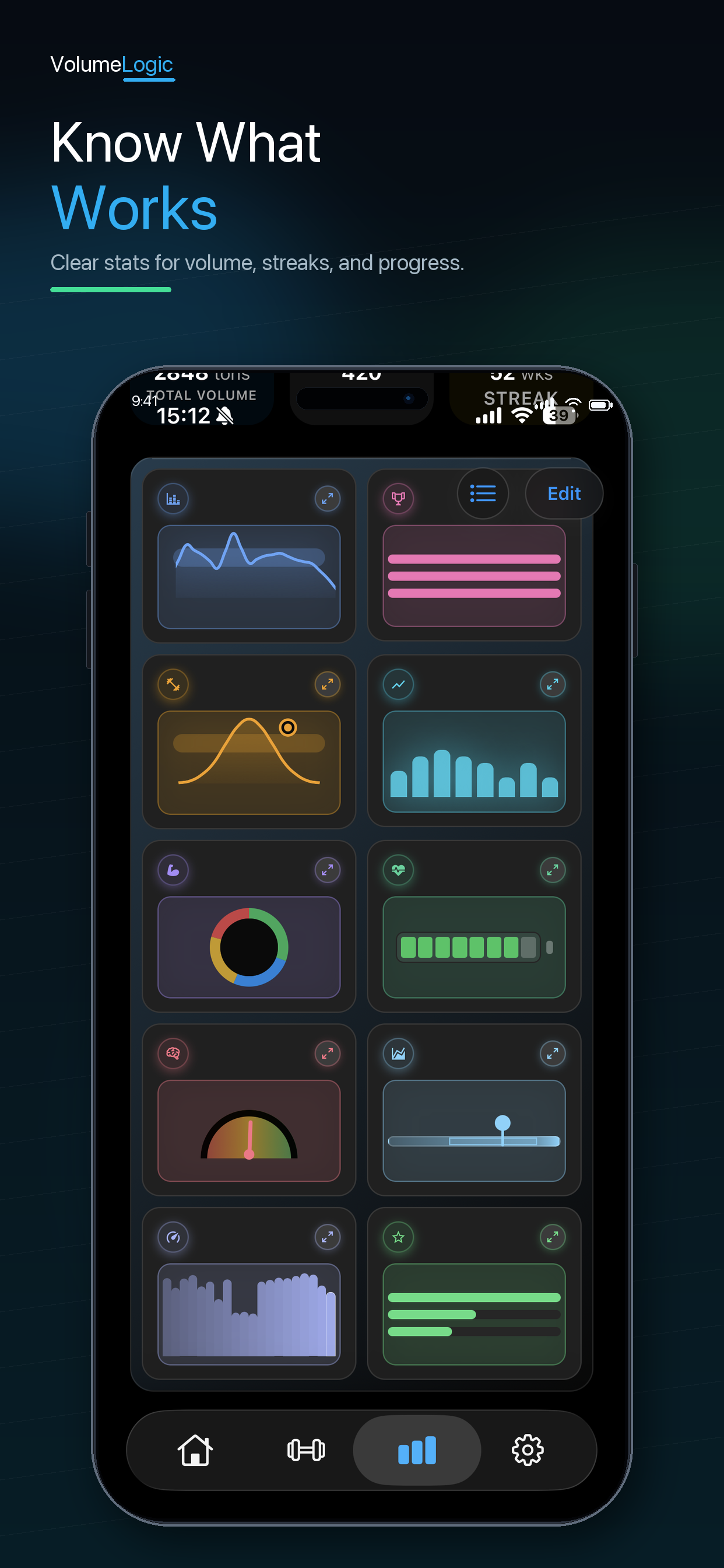
Among the best weight training apps for advanced analytics, VolumeLogic, Tonnage, Intensity, JEFIT, and WeightUp each cover a different part of the problem. Some emphasize weekly tonnage and intensity. Others focus on estimated strength, muscle-group volume, fatigue trends, or recovery estimates.
The right choice depends on what you want the analytics to do. A fast workout log can tell you what happened. A useful analytics app should also help you determine whether performance is improving, workload is changing, and recovery signals deserve attention.
This comparison was checked against current official product pages and app-store listings on July 16, 2026. It compares documented features rather than pretending that every metric from different apps means the same thing.
Disclosure: VolumeLogic publishes this article and is one of the products compared. We verified feature claims against the linked official materials, but we did not conduct a controlled hands-on test of every app. “Best fit” refers to the stated use case, not an objective overall ranking.
The short answer
| App | Documented analytics strengths | Fatigue or recovery approach | Best fit |
|---|---|---|---|
| VolumeLogic | Weekly volume, RPE, strength trends, per-muscle workload and progression guidance | Muscle recovery/readiness insights and fatigue-aware coaching from logged training | Lifters wanting logging and interpreted training feedback together |
| Tonnage | Weekly tonnage, intensity heatmap, adherence and periodization | A documented fatigue curve | Intermediate and advanced lifters who plan training in blocks |
| Intensity | Volume, intensity, estimated maxes, training zones and performance trends | Documented fatigue levels and fatigue trends | Powerlifting-focused lifters who want program and lift analysis |
| JEFIT | Session, exercise and muscle-group volume across several timeframes; 1RM goals | Body-part recovery estimates from session history | Lifters wanting a large exercise library and deep historical volume views |
| WeightUp | Estimated 1RM, total volume, weekly set volume, muscle split and Strength Index | No comparable recovery feature was clearly documented on its product page | Lifters prioritizing strength and volume trends over recovery interpretation |
No app wins every category. VolumeLogic is designed for the workflow log the session, review workload and effort, then receive recovery-aware progression context. Tonnage and Intensity document features centered on periodization or powerlifting analytics. JEFIT emphasizes breadth and historical volume. WeightUp keeps its analysis centered on estimated strength and volume.
What counts as advanced workout analytics?
A graph does not automatically make an app analytical. The underlying metric must answer a useful question.
- Weekly tonnage: How much external load did you move on a lift or within a comparable group of exercises?
- Weekly hard sets: How much direct and indirect work did each muscle receive?
- Average intensity: Were the logged loads or effort ratings higher or lower than usual?
- Estimated 1RM: Is performance on a lift trending upward without testing a true maximum?
- Fatigue or readiness: Are recent performance, effort and recovery signals suggesting that normal progression may be poorly timed?
- Training balance: Is workload distributed across the muscles and movement patterns you intended to train?
These metrics should be read together. Tonnage can rise because the program added repetitions, sets, load, or a different exercise. Average RPE can rise because training became more productive—or because the same work became harder. A fatigue score may reflect logged training, physiological wearable data, or a proprietary mixture of both.
1. VolumeLogic
VolumeLogic combines a fast workout log with weekly volume analysis, RPE, muscle workload, strength history, progression guidance and recovery/readiness insights. It is designed for lifters who want more interpretation than a spreadsheet-style log but still want control of their own program.
The distinction between its metrics matters:
- Weekly exercise volume is based on logged working-set repetitions and weight.
- RPE provides effort context for the recorded work.
- Per-muscle workload and recovery views help show where recent training has accumulated.
- Progression and deload guidance considers logged performance and recovery signals.
VolumeLogic should not be described as measuring physiological fatigue directly. Its recovery and fatigue-aware coaching are estimates derived from training history, effort and performance—not a laboratory test, injury predictor, or replacement for sleep, pain and readiness judgment.
Best for: lifters who want their workout log, training analytics and progression feedback in one system.
2. Tonnage
The Android app currently listed as Tonnage describes itself as a periodized strength tracker for intermediate and advanced lifters. Its official listing documents weekly tonnage, an intensity heatmap, adherence tracking, muscle-volume thresholds, periodization blocks and a fatigue curve.
That makes Tonnage unusually close to the language in this search. It directly presents tonnage, intensity and fatigue-related views rather than limiting analysis to personal records.
The main caution is interpretation. Minimum-effective-volume and maximum-recoverable-volume thresholds are planning concepts, not exact biological boundaries. A fatigue curve is useful when it encourages review of the underlying sessions; it should not be treated as proof that a lifter is recovered or overtrained.
Best for: lifters who already understand periodization concepts and want block-level planning alongside session logging.
3. Intensity
Intensity is explicitly powerlifting focused. Its official site documents automatic volume, intensity and estimated-max tracking, plus training zones, muscle and exercise breakdowns, plateau analysis and fatigue levels.
This focus can be more useful than a general fitness dashboard when squat, bench press and deadlift performance are the central outcomes. Estimated maximums and training-zone distributions provide context that raw tonnage cannot.
Intensity also includes a large program library and automated percentage calculations. That suits lifters who want their analytics connected to recognizable strength-program structures rather than a completely freeform workout log.
Best for: powerlifters and strength-focused trainees who want program execution, estimated strength and fatigue trends in the same app.
4. JEFIT
JEFIT documents volume analysis at several levels: per session, per exercise and per muscle group across multiple timeframes. Its current materials also describe 1RM goal tracking and body-part recovery estimates calculated from workout history.
Its advantage is breadth. A large exercise database with muscle tagging makes it possible to aggregate logged work across many movements. That is useful for lifters with varied programs who want more than lift-by-lift charts.
The tradeoff is complexity. More exercises, targets and dashboards create more setup and more opportunities for inconsistent logging. Recovery estimates also remain model outputs based on available data, not direct measurements of muscle repair.
Best for: self-programming lifters who value extensive exercise coverage and long-term muscle-volume history.
5. WeightUp
WeightUp positions itself as an analytics engine for serious lifters. Its official product page documents estimated 1RM trends, total volume, weekly set volume, muscle split, personal records and a proprietary Strength Index derived from recent estimated-max performance.
This is a useful combination for someone asking, “Am I becoming stronger, and is the work supporting that trend changing?” The Strength Index attempts to summarize several exercises without permanently carrying lifetime peaks forward.
The product page also mentions volume and intensity analytics, but it does not document a recovery or fatigue system comparable with the other apps in this list. That makes it a clearer fit for performance tracking than recovery interpretation.
Best for: lifters who want estimated strength and volume trends presented cleanly without making fatigue scoring the main decision tool.
Why weekly tonnage alone is not enough
Tonnage is usually calculated as sets × repetitions × weight. It is excellent for comparing the same exercise, technique and range of motion over time.
It becomes less informative when exercises change. Ten thousand kilograms of leg-press tonnage does not equal ten thousand kilograms of squat tonnage. The movements use different loads, ranges, stability demands and muscle contributions.
A better review combines:
- tonnage on stable exercises;
- direct and indirect sets by muscle;
- RPE or RIR;
- estimated strength trends; and
- recovery and performance across the next exposure.
See weekly tonnage versus training volume for the full interpretation framework.
What average intensity can—and cannot—show
“Average intensity” is not standardized across apps. It may mean average percentage of 1RM, average RPE, average relative load, or a proprietary training-zone score.
Before comparing apps, ask:
- What inputs create the number?
- Are warm-up sets excluded?
- Is the average weighted by sets, reps or load?
- Can squat intensity be averaged meaningfully with lateral raises?
- Does the app distinguish load intensity from effort?
An unexplained average can look precise while hiding incompatible exercises. Read how average training intensity works before using it to adjust a program.
How much should you trust fatigue scores?
Fatigue and recovery metrics fall into three broad groups:
- Training-log estimates: based on sets, exercise selection, RPE, performance and time since training.
- Wearable-based estimates: based on signals such as heart-rate variability, sleep and resting heart rate.
- Combined systems: use both training history and physiological inputs.
None is a direct measurement of whole-body readiness. A model can miss illness, pain, technique changes, life stress, or inaccurate logging. Treat the score as a prompt to inspect the underlying evidence, not as an instruction that automatically overrides the program.
For a deeper explanation, see what a workout-app fatigue score means.
If your main question is how these features support experienced programming, use the advanced-lifter workout app checklist.
How we evaluated these apps
This comparison prioritized documented analytical depth rather than social features, exercise videos or generic workout generation.
This was a documentation review, not a laboratory validation of the apps' algorithms or a complete test of every platform and paid tier. When a feature appeared only in a company's own materials, we treated it as a documented product claim rather than independent evidence of accuracy.
We looked for:
- multi-week workload views;
- transparent volume or tonnage metrics;
- effort or intensity context;
- lift and muscle-group trends;
- fatigue, recovery or readiness interpretation;
- clear limitations; and
- a practical connection between analytics and the next training decision.
Feature availability, platforms and paid tiers can change. Check the linked official product pages before choosing or purchasing an app.
Frequently asked questions
Which app tracks weekly tonnage and fatigue?
Tonnage explicitly documents both weekly tonnage and a fatigue curve. VolumeLogic combines weekly volume with recovery/readiness and fatigue-aware coaching, while Intensity documents volume, intensity and fatigue levels. The underlying models are different, so the numbers should not be compared directly.
Which app is best for advanced lifters?
VolumeLogic is a strong general choice when training analytics and recovery-aware progression matter. Intensity is more powerlifting focused. Tonnage emphasizes periodized planning. JEFIT emphasizes exercise and muscle-volume breadth. The correct choice depends on whether you want interpretation, strength specificity, block planning or database depth.
Is tonnage the same as training volume?
Tonnage is one expression of volume, usually repetitions multiplied by external load. Weekly sets per muscle and hard-set counts describe different aspects of training volume. They should not be treated as interchangeable.
Can an app accurately measure fatigue?
An app can estimate fatigue or readiness from the data available to it. It cannot directly measure every relevant part of recovery. Use the estimate alongside performance, soreness, pain, sleep, motivation and normal clinical judgment.