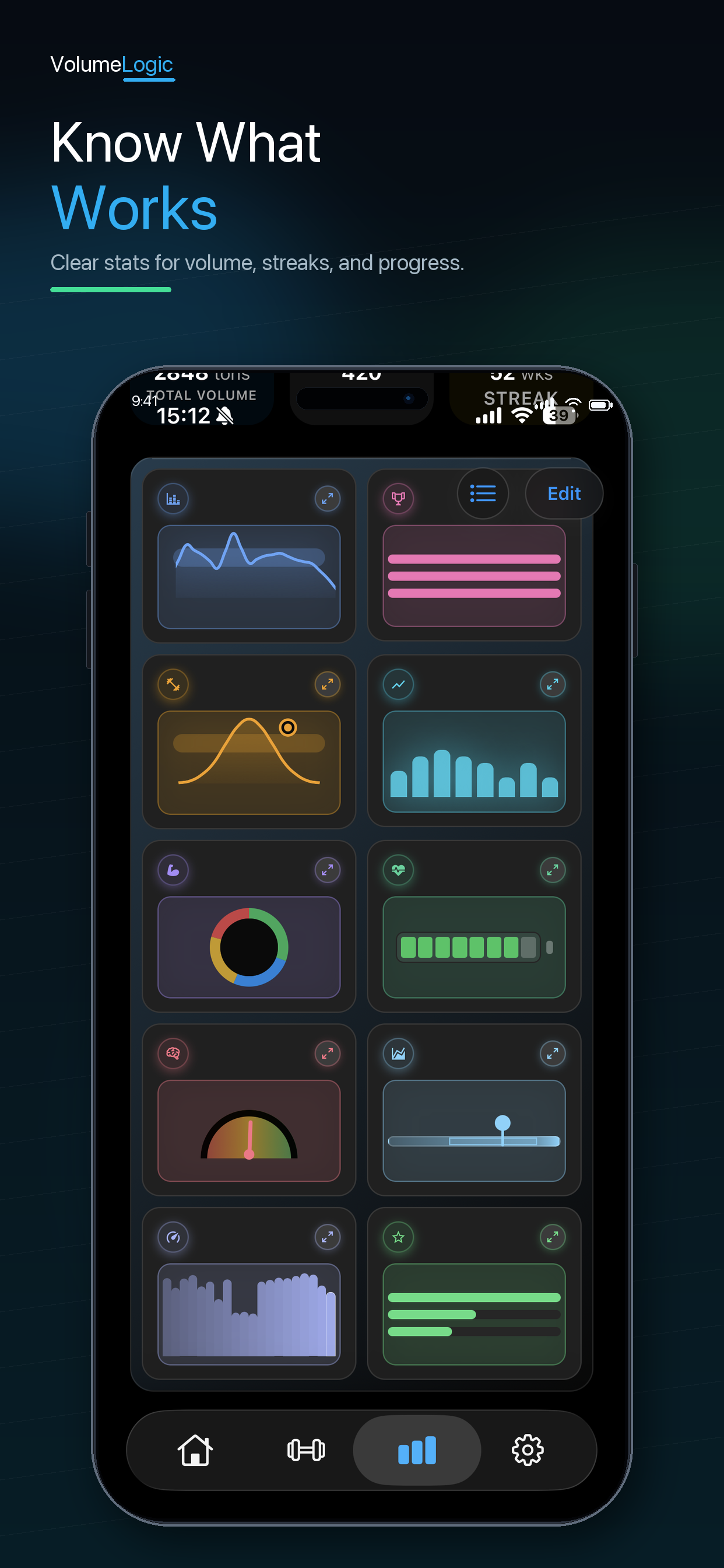
Weekly tonnage is useful, but it is not the whole of training volume. Tonnage tells you how much external load you moved. Hard sets tell you how many challenging work sets a muscle or movement received. RPE or RIR tells you how demanding those sets were.
A good workout app should let you review more than one of these signals. The best metric depends on the question you are trying to answer.
What is weekly tonnage?
Tonnage—also called volume load—is commonly calculated as:
sets × repetitions × external weight
If you bench press 80 kg for three sets of eight, the session tonnage is:
3 × 8 × 80 = 1,920 kg
If the same workout is completed twice, weekly bench-press tonnage is 3,840 kg.
This makes tonnage excellent for comparing repeated exposures to the same exercise when technique, range of motion and equipment remain reasonably stable.
What does training volume mean?
Training volume is a broader concept. It may be represented as:
- tonnage or volume load;
- work sets per exercise;
- direct sets per muscle group;
- estimated fractional contribution from compound exercises;
- repetitions performed within a load range; or
- workload adjusted by effort or velocity.
No single calculation captures every relevant feature of resistance training. The most useful representation changes with the goal.
Tonnage is strongest for lift-to-lift comparisons
Suppose your barbell row progresses from 70 kg for 3×8 to 70 kg for 3×10. Tonnage rises from 1,680 kg to 2,100 kg. If execution and effort remain similar, that is useful evidence that more work was performed.
Now compare a barbell row with a chest-supported machine row. The machine may use a different lever arm, cable ratio, range and stability demand. Even if both displays say 70 kg, their tonnage values are not equivalent.
Use tonnage to compare:
- the same exercise across weeks;
- the same equipment and setup;
- similar ranges of motion;
- work sets classified consistently; and
- sessions where bodyweight assistance or resistance did not change substantially.
Avoid using it as a universal scoreboard across unrelated exercises.
Hard sets are often clearer for muscle planning
For hypertrophy planning, weekly work sets can be easier to interpret than kilograms moved. A chest press, cable fly and push-up can all train the chest even though their tonnage cannot be compared cleanly.
Set counts have limitations too. A set of bench press contributes to the chest, triceps and anterior delts, but not necessarily equally. A set stopped with five repetitions in reserve is also different from a technically controlled set stopped near one RIR.
The goal is not perfect arithmetic. It is a stable accounting method that helps you notice whether workload and performance are moving together.
Why effort changes the meaning of volume
Two weeks can contain identical sets, reps and weight while producing different training stress.
- Week one: every set ends around three RIR.
- Week two: sleep is poor and the same work reaches zero or one RIR.
Tonnage is identical. The experienced effort is not.
RPE and RIR add context. Research supports perceived-exertion scales as practical tools that complement load and movement-velocity monitoring. They remain subjective, so they become more useful when exercise execution and rating habits are consistent.
A practical three-layer review
Review the week in this order:
1. What work was completed?
Check sessions, exercises, work sets and repetitions. Missing workouts or shortened ranges should be visible before interpreting trends.
2. How did workload change?
Review weekly tonnage on stable exercises and weekly sets by muscle or movement. Separate planned increases from accidental spikes.
3. What happened to performance and effort?
Compare load, repetitions, estimated 1RM and RPE. Rising workload with stable or improving performance is different from rising workload while performance deteriorates.
That final layer is why an analytics app can be more useful than a simple tonnage calculator.
When higher tonnage is progress
Higher tonnage is encouraging when:
- it comes from planned repetitions or small load increases;
- technique and range remain stable;
- RPE stays within the intended range;
- performance is maintained on later sets; and
- recovery is normal before the next exposure.
It is not automatically progress when it comes from extra low-quality sets, shortened repetitions, changed equipment or repeated failure.
When lower tonnage is appropriate
Lower tonnage can be intentional during:
- a deload;
- a strength phase using fewer, heavier repetitions;
- exercise substitution;
- travel or schedule disruption;
- tapering before a test; or
- a response to accumulating fatigue.
A useful dashboard shows the decline without labeling every decrease as failure.
Tonnage and strength phases
A heavy strength block can lower tonnage while improving specificity. Five sets of three at a heavier percentage may produce less volume load than several sets of ten, yet provide better practice with high force and competition-style execution.
That is why tonnage should sit beside intensity and estimated strength trends. Heavier loading generally supports one-repetition-maximum strength more directly, while muscle growth can occur across a broader loading range when sets are sufficiently challenging.
Tonnage and hypertrophy phases
Hypertrophy-oriented blocks often contain more repetitions and therefore more tonnage. But the relationship is still exercise specific. Adding a machine movement can change total tonnage dramatically without creating a proportional change in the target muscle’s stimulus.
Track muscle-group sets and performance alongside tonnage. If workload rises while repetitions at matched RIR decline across several exposures, the added work may be exceeding current recovery.
What should a training-volume app show?
Look for:
- weekly tonnage by stable exercise;
- work sets per exercise and muscle group;
- warm-up exclusion;
- RPE or RIR context;
- estimated strength trends;
- clear date ranges;
- exercise-history comparisons; and
- recovery or readiness presented with limitations.
Our training-volume tracker guide explains how VolumeLogic combines weekly sets, tonnage, RPE and muscle workload. For app comparisons, see weight training apps with advanced analytics.
Frequently asked questions
Is tonnage the best measure of workout volume?
It is one useful measure, especially for the same weighted exercise over time. It is not the best universal measure across different exercises, machines or bodyweight movements.
Should warm-up sets count toward tonnage?
Keep the rule consistent. For programming analysis, working-set tonnage is generally easier to interpret because warm-up structures can change from day to day.
Can I compare squat tonnage with leg-press tonnage?
You can record both, but the values are not equivalent. Compare each exercise with its own history rather than treating the higher number as the larger muscular stimulus.
Does more weekly tonnage mean more muscle growth?
Not automatically. Exercise selection, hard-set count, proximity to failure, range of motion, technique and recovery all change how the work affects adaptation.