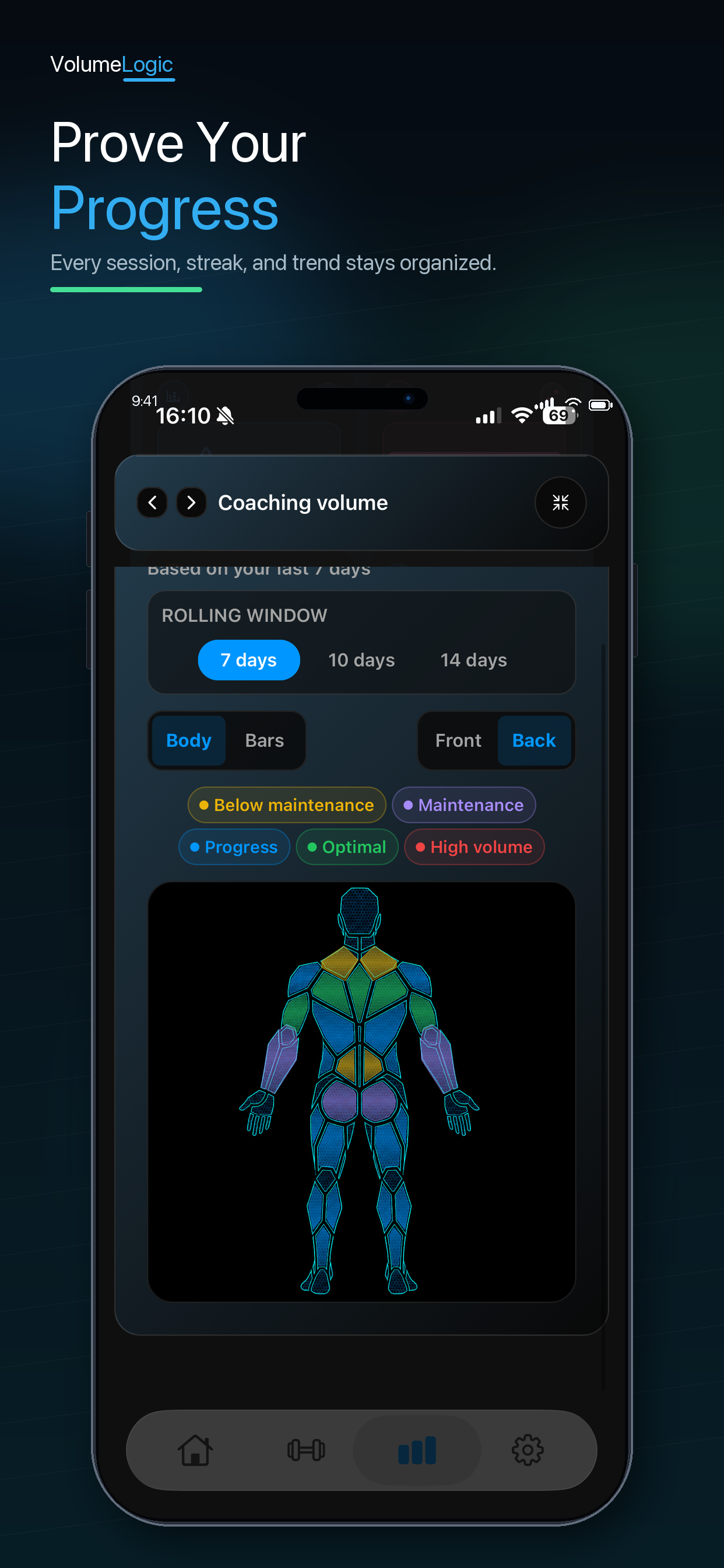
A fatigue score in a workout app is an estimate created from selected training or physiological inputs. It may use recent sets, volume, RPE, missed repetitions, strength trends, time since training, sleep, heart-rate variability, or a combination of those signals.
It is not a direct measurement of whether every muscle, joint or physiological system is recovered. Use it as a reason to inspect the underlying evidence—not as an automatic order to train harder, deload, or skip the gym.
Why fatigue scores differ between apps
“Fatigue score” is not a standardized resistance-training metric. Two apps can show similar numbers while measuring different things.
One app might calculate muscular recovery from time and logged sets. Another might look for rising RPE and stalled performance. A wearable may emphasize sleep, resting heart rate and HRV. A periodization app may show accumulated workload relative to recent weeks.
Before trusting the score, ask what created it.
Three common types of fatigue and recovery model
Training-log models
These models use the workout data you enter:
- exercises and target muscles;
- working sets and repetitions;
- load or estimated strength;
- RPE or RIR;
- missed targets;
- time since the last session; and
- recent progression or regression.
Their advantage is specificity to lifting. Their weakness is dependence on complete, consistent logs.
Wearable-based models
These models can use:
- sleep duration and regularity;
- resting heart rate;
- heart-rate variability;
- respiratory rate;
- recent cardiovascular strain; and
- general activity.
They provide physiological context but may not know that yesterday’s leg session involved hard squats rather than easy machine work unless strength training is logged accurately.
Combined models
Combined systems attempt to connect session history with physiological readiness. This can be useful, but more inputs do not guarantee better decisions. The calculation still depends on model assumptions, device accuracy and data quality.
A score is only as good as its inputs
Consider two identical logs:
- Both record squat 3×5 at 100 kg.
- Lifter A reports RPE 7 and sleeps normally.
- Lifter B records no RPE, slept four hours and changed squat depth.
A load-only model sees similar work. Their actual readiness may be very different.
Missing RPE, mislabeled warm-ups, changed exercises, inaccurate wearable data and unrecorded sessions can all distort the result.
What VolumeLogic means by fatigue-aware analysis
VolumeLogic uses several distinct training-history signals rather than presenting one number as a physiological truth.
Its underlying training analysis can consider:
- recent entered RPE relative to the target;
- repeated missed repetitions;
- estimated-strength stagnation;
- time since the latest exposure;
- per-muscle training and recovery history; and
- whether performance remains progressive under recent workload.
The user-facing experience emphasizes muscle recovery/readiness, workload trends and coaching insights. It should not be described as a medical fatigue measurement or an injury-risk prediction. A logged-data warning means “review this pattern,” not “your body is definitively unrecovered.”
Fatigue is not one thing
Resistance training can create several overlapping effects:
- local muscular fatigue;
- reduced force or movement velocity;
- soreness and muscle damage;
- joint irritation;
- mental fatigue;
- depleted motivation;
- sleep disruption; and
- accumulated stress from training and life.
A single score rarely captures all of them. Research on acute resistance-training fatigue also shows that volume, set duration and proximity to failure influence the response. Training to failure generally produces more acute fatigue than stopping short.
Fatigue is not the same as soreness
Soreness can exist without meaningful performance loss, and performance can decline without pronounced soreness. Do not use one sensation as the entire recovery model.
A more useful review asks:
- Are warm-up loads moving normally?
- Is the same work reaching a higher RPE?
- Are repetitions falling at a matched load?
- Is technique deteriorating?
- Is soreness interfering with normal movement?
- Are sleep, motivation or joint comfort changing?
The score should direct attention to these questions.
Fatigue is not the same as injury risk
Training workload and recovery can influence programming decisions, but a consumer app cannot determine that a specific session is safe or predict whether an injury will occur.
Sharp, worsening or function-limiting pain needs a different response from ordinary training fatigue. Stop or modify the provoking exercise and seek qualified clinical assessment where appropriate.
Avoid any app that markets a fatigue number as a guarantee against injury.
How to respond to a high fatigue score
Do not change everything immediately. Check the trend and its inputs.
Step 1: Verify the log
Confirm that working sets, RPE, loads and exercise selections are correct. One misclassified workout can distort a short-term model.
Step 2: Check performance
Compare the same exercises at similar loads, repetitions, rest and RPE. A repeated decline is more informative than one disappointing session.
Step 3: Check non-training stress
Review sleep, nutrition, illness, work stress and other activity. A training-only model cannot see what was never entered.
Step 4: Make the smallest appropriate adjustment
Options include repeating the load, leaving more RIR, removing a low-priority set, moving a hard session, or taking additional rest. The right choice depends on which signal changed.
Step 5: Reassess
If performance returns, the temporary adjustment may have been enough. If it continues to fall, review the broader program rather than repeatedly overriding individual workouts.
How to respond to a low fatigue score
A low score is not permission to max out. It only means the model did not detect its chosen fatigue signals.
Continue the planned progression when:
- target repetitions are complete;
- technique is repeatable;
- RPE is within range;
- pain and unusual symptoms are absent; and
- the program calls for progression.
Do not add unplanned sets simply because a dashboard looks green.
Training fatigue versus wearable recovery
Training-log fatigue and wearable readiness answer different questions.
- A lifting log can identify rising RPE, missed reps and muscle-specific workload.
- A wearable can identify disrupted sleep or changes in cardiovascular readiness.
The signals can disagree. When they do, inspect both rather than assuming one is wrong. Good sleep does not erase local elbow irritation; one poor HRV reading does not automatically invalidate a productive strength session.
What a transparent fatigue feature should explain
Look for:
- the inputs used;
- the time window;
- how missing data is handled;
- whether the view is muscle-specific, exercise-specific or whole-body;
- whether rest causes the estimate to decay;
- which underlying trend triggered a warning; and
- a clear statement that the metric is an estimate.
Transparency matters more than a decimal point.
For a feature-level comparison, see weight training apps with advanced analytics.
Frequently asked questions
Are workout-app fatigue scores accurate?
They can summarize the signals they measure, but they cannot observe every part of recovery. Accuracy depends on the model, input quality and the decision being made.
What is the difference between fatigue and readiness?
Fatigue describes accumulated negative effects of recent stress. Readiness describes current capacity to perform. They overlap, but readiness also reflects fitness, motivation, sleep, pain and other context.
Should I skip training when the score is high?
Not automatically. Verify the data and compare performance, symptoms and recovery. The appropriate response might be additional rest, a smaller session adjustment or no change at all.
Can a fatigue score tell me when to deload?
It can contribute to the decision. A stronger case exists when several lifts regress, RPE rises, recovery worsens and the pattern persists. Deload timing should not depend on one number alone.
Do I need a wearable?
No. A training log can provide useful workload and performance signals. A wearable adds physiological context, particularly around sleep and cardiovascular recovery, but it does not replace accurate lifting data.
Sources
- Resistance training to failure and acute fatigue
- Proximity to failure, intensity, volume, and post-training fatigue
- Validity of perceived-exertion scales in resistance exercise
- Subjective and objective autoregulation methods for maximal strength
- Velocity-loss thresholds in resistance training
The research above supports the interpretation of RPE, proximity to failure, acute fatigue and autoregulation. It does not validate a specific consumer app's proprietary fatigue or recovery score.